On this page
Chinese cooking includes many regional traditions, ingredients and techniques. 中国菜 (Zhōngguó cài) means Chinese food or cuisine; it is not defined by an official ranking of three world cooking styles.
A familiar way to discuss regional cooking is the “eight great cuisines” (八大菜系), though this classification does not cover every tradition. Here are fifteen dishes to recognize on a menu.
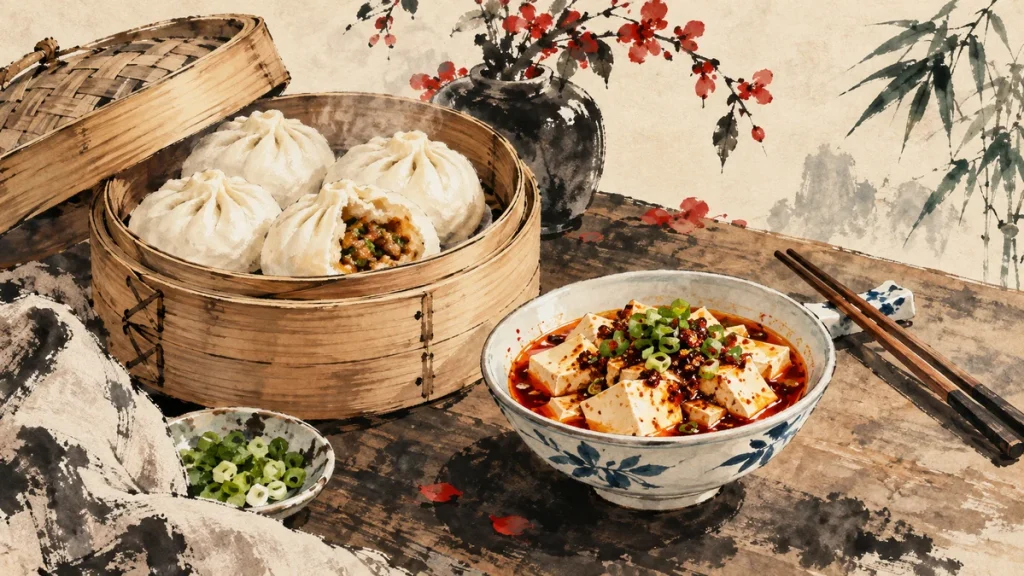
包子 (bāo zi) Steamed Buns
包子 (bāozi) are filled buns, commonly steamed and often eaten for breakfast. Stories link ancient steamed bread to Zhuge Liang (诸葛亮), but should not be treated as proof that he invented modern filled buns because unfilled bread lacked nutrition.
Buns are made of flour and meat or vegetable stuffing, there could be many flavors, such as seafood buns (海鲜包), soy sauce pork buns (酱肉包) and vegetable buns (素包子). Varieties include fried buns (煎包), mini-buns (小笼包), and soup buns (灌汤包).

via Pixabay
饺子 (jiǎo zi) Dumplings
饺子 (jiǎozi) are dumplings made by wrapping filling in dough, often folded into a crescent shape. 馄饨 (húntun) are wontons, typically with thinner wrappers and often served in soup. These are related food traditions, rather than evidence for a simple, established evolution from one to the other.
There could be boiled dumplings (水饺), steamed dumplings (蒸饺) or fried dumplings (煎饺); and fillings could be meat or vegetable, sweet or salty, whatever your choice. Dumplings are often eaten on the Chinese New Year (春节), and the Winter Solstice Festival (冬至).

via Pixabay
春卷 (chūn juǎn) Spring Rolls
春卷 (chūnjuǎn) are spring rolls, often associated with spring celebrations. 春饼 (chūnbǐng) are spring pancakes: a related but distinct food, not simply another name for fried spring rolls.
Spring rolls are made using a round layer dough to wrap sliced vegetables or meat, rolled up and then fried until it’s golden brown. The cooks could be quite creative with the materials, and some popular ingredients include pork, beef, mutton, cabbage, vermicelli, celery, and shredded tofu

via Pixabay
凉皮 (liáng pí) Cold Rice Noodles
凉皮 (liángpí) are cold noodle-like sheets or strips associated with Shaanxi. They may be made from wheat or rice; “cold rice noodles” does not describe every variety. Claims about a precise Qin-dynasty origin are uncertain.
凉皮 is made of rice or flour, chopped into thin strips and stirred with sauce, made into different flavors such as spicy or sour & sweet. 凉皮 is usually eaten cold in the summertime to help people relieve the heat and increase their appetite. It should be chewy, thin and soft.
麻婆豆腐 (má pó dòu fu) Mapo Tofu/Beancurd
Another translation being “sauteed tofu in hot and spicy sauce”, Mapo Tofu is a famous dish of the “Sichuan cuisine (川菜)”; which is known for spicy and hot food. This dish is named after its creator’s nickname 陈麻婆 (chén má pó). The main ingredients are bean sauce, tofu, ground beef (or pork), chilli and pepper.
The cooking technique is to fry a tablespoon of vegetable oil in a pan, then add a handful of crushed chilli, then beef, and add bean sauce when the pan is nearly dry. Then tofu blocks are to be added, with a bit of water. Stir evenly, cover the pot and use low heat to dry the soup, then sprinkle pepper powder before the fire is turned off.

via Pixabay
大盘鸡 (dàpánjī) Saute Spicy Chicken
Literally translated, this means “a big (大) plate (盘) of chicken (鸡)”; which originated from Xin Jiang (新疆). This is a relatively new dish which was invented in the 1980s, originally named “Fried Chicken with Chilli (辣子炒鸡)”.
It is often made with chicken, potatoes, peppers, onions; and an additional bowl of wide noodles is often served as a side dish, for the customers to dip sauce and eat as the staple food. Some restaurants would also offer “Small Plate Chicken (小盘鸡)”, which is in less quantity.
宫保鸡丁 (gōng bǎo jī dīng) Kung Pao Chicken
The sweet and spicy Kung Pao Chicken is one of the most popular dishes among foreigners, found on many Chinese restaurant menus worldwide. It is included in several “cuisine systems (菜系)”, such as “Sichuan cuisine (川菜)”, “Shandong cuisine (鲁菜)” and “Beijing royal cuisine (北京宫廷菜)”.
Made from chicken, peanuts, diced cucumber, dried red pepper, and other ingredients; Kung Pao Chicken is “red but not spicy”, “spicy but not fierce”, “tasteful and crispy”.
水煮牛肉 (shuǐ zhǔ niú ròu) Poached Sliced Beef in Hot Chili Oil
Judging from the name, “water (水) boiled (煮) beef (牛) meat (肉)”, some might think this is a light dish. On the contrary, “Boiled Beef” is one of the hottest and spicy dishes of the “Sichuan cuisine (川菜)”.
The main ingredients include lean beef, bean sprouts, duck blood curds, lettuce or other vegetables. This dish is spicy and tasteful, smooth and soft, which has a strong smell. It also has the numbing (麻), spicy (辣) and hot (烫) characteristics of Sichuan Hotpot.
If made by pork, then it would be called 水煮肉片 (water boiled sliced meat); if made with fish, then it would be named 水煮鱼 (water boiled fish).
糖醋里脊 (táng cù lǐ jǐ) Sweet and Sour Pork Fillet
This is a traditional dish included in many “cuisine systems (菜系)” as well, such as “Zhejiang cuisine (浙江菜)”, “Shandong cuisine (鲁菜)”, and “Guangdong cuisine (粤菜)”. The main ingredient is griskin, which would be wrapped in starch (淀粉) and then fried twice.
糖醋里脊 is known for its sweet-and-sour sauce and crisp coating. Recipes vary in their balance of sweetness and acidity.

via Pixabay
腰果虾仁 (yāo guǒ xiā rén) Fried Shrimp with Cashews
Being from “Guangdong cuisine (粤菜)”, and as its name suggests, the main ingredients are peeled shrimps/prawns and cashew nuts. Supplementary ingredients include eggs, water starch (水淀粉), chopped green onion, garlic slices, and ginger.
This dish combines shrimp and cashews with a savory sauce. Ingredients vary by restaurant; check with the restaurant if you need to know the exact ingredients.
重庆烤鱼 (Chóngqìng kǎoyú) — Chongqing Grilled Fish
重庆烤鱼 is associated with Chongqing-style cooking. Origin stories vary, so an exact inventor and late-Qing date should not be assumed.
It combines three cooking techniques: marinating, baking and stewing; also borrowing characteristics from traditional Sichuan cuisines and hotpot, in creating a “tender but crispy” taste.
Subsidiary vegetables such as bean sprouts, lettuce, potatoes, mushrooms, onions, and tomatoes could be added according to your requirements. Qingjiang fish (清江鱼) is the “public choice” as it has fewer spines and more meat.
Grass carps (草鱼) are also often chosen as it absorbs flavors better. Popular flavors include hot and spicy (香辣), fermented soya beans (豆豉), garlic (蒜香), and tomato (番茄).
红烧狮子头 (hóng shāo shī zǐ tóu) Braised Pork Balls in Brown Sauce
If translated word-by-word, it could mean “braised (红烧) lion (狮子) heads (头)”, which is actually made of pork. 四喜丸子 (Four-Joy Meatballs) is a related meatball dish, rather than an exact synonym. 狮子头 is associated with Huaiyang cooking (淮扬菜), which originated in southern China.
Chopped meat (both fatty and lean meat) added with water chestnuts (荸荠), mushrooms, or lotus root is made into balls, first fried then braised with low fire using casseroles (砂锅). These “lion heads” are elastic, soft and smooth, also representing “reunion and happiness 团团圆圆 (ball & round)”.
炸酱面 (zhá jiàng miàn) Noodles with Soy Bean Paste
This “fried (炸) sauce (酱) noodles (面)” originated in Beijing and belongs to the “Shandong cuisine (鲁菜)”, which is widely popular in Northern China.
Boiled noodles will be run through cold water, drained, and then mixed with soybean sauce or sweet flour paste with diced meat. Also adding shredded vegetables such as cucumbers, bean sprouts, and carrots. The sauce is savory; vinegar, chili and garnishes may be added according to preference.
炸酱面 combines noodles with a savory sauce and vegetable garnishes.

via Pixabay
北京烤鸭 (běi jīng kǎo yā) Beijing Roast Duck
Roast duck is a famous Beijing dish with a worldwide reputation that originated in the Southern and Northern Dynasties (南北朝) of China. It was an imperial food then. Nowadays, 挂炉烤鸭 (hanging oven) and 焖炉烤鸭 (braised oven) are the two main genres of Beijing roast duck.
A duck will be sliced by the waiter and you will be served with lotus leaf-shaped pancakes (荷叶饼), sweet soybean sauce (甜面酱), green onion strips, cucumber strips, and radish strips. You could dip some sauce on a pancake, place a piece of roast duck, some vegetable strips, and then wrap up the pancake to have a bite. The duck is crispy on the outside and juicy in the inside.

via Pixabay
火锅 (huǒ guō) Hotpot
火锅 (huǒguō) refers to cooking and eating ingredients in a shared pot of simmering broth. Versions differ widely by region; a single, exact ancient origin is not established here.
The feature of hotpot is to eat while the pot is boiling, there are different “soup bases (锅底)” such as two-flavored (鸳鸯),hot and spicy (麻辣) and light-flavored (清淡).
People would put ingredients in the boiling pot, fetch them out with chopsticks and dip in various sauces. Some restaurants even allow customers to mix and modulate their own sauce. Typical hot pot ingredients include various meat, seafood, vegetables, soybean products, mushrooms, egg products, and glass noodles.

via Pixabay
These are some of the most tasty dishes which we would recommend, and there’s always more waiting for you to discover. But please note that the Chinese food in China will be significantly different from what one would find in Chinatowns abroad. We hope that you would be able to find some of your own favorites in both.